
 German
 Japanese
 Arabic
 Spanish
 French
 Russian
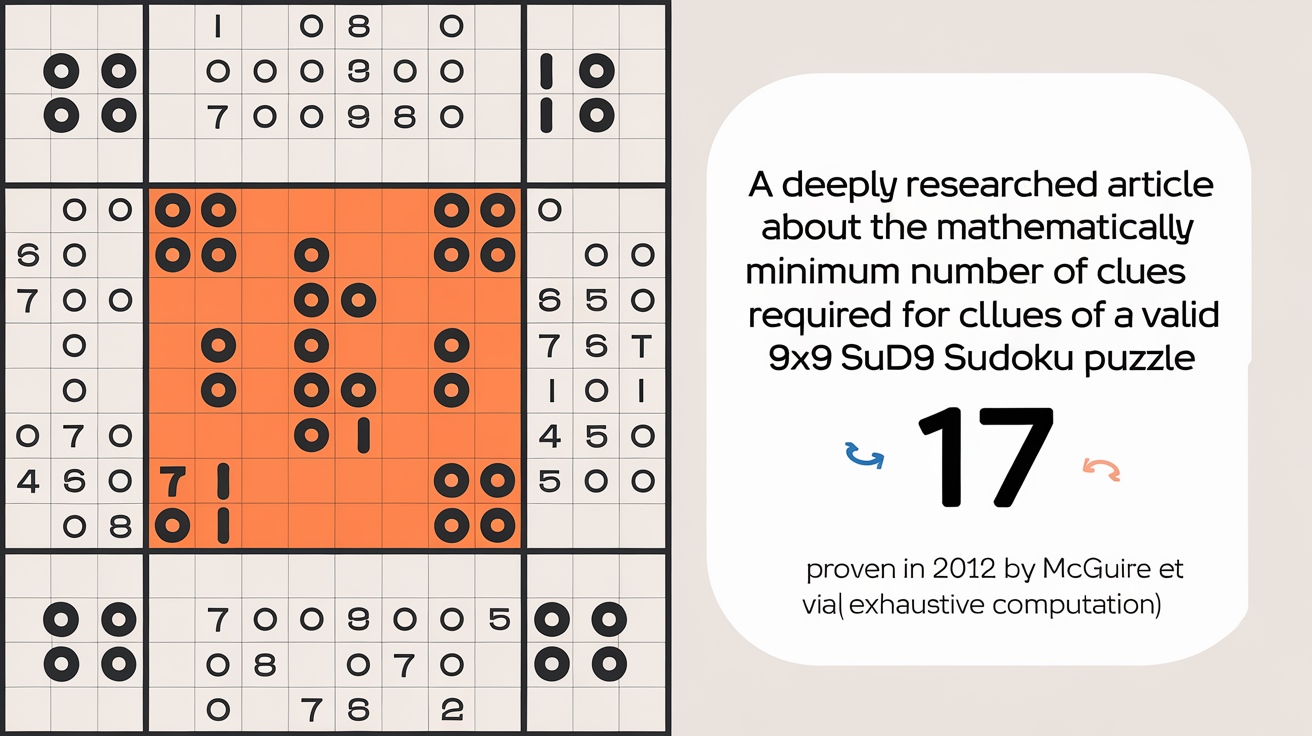
The Quest for Sudoku's Mathematical Foundation
In 2012, after decades of computational effort, a team of mathematicians led by Gary McGuire at University College Dublin announced a result that settled one of recreational mathematics' most tantalizing questions: what is the absolute minimum number of clues needed to create a valid 9×9 Sudoku puzzle with a unique solution?
The answer: 17.
This wasn't a lucky guess or an informed estimate. It was proven through exhaustive computational search—a mathematical verification so comprehensive that it leaves no room for doubt. No valid 9×9 Sudoku puzzle with a unique solution exists with only 16 clues. But infinitely many exist with 17. This seemingly simple number represents a profound mathematical boundary, one that reveals deep truths about the nature of logic puzzles, computational complexity, and the hidden structure of Sudoku itself.
Understanding the Problem: Why This Matters
Before we dive into how mathematicians proved this, let's clarify why anyone should care. Sudoku puzzles sit at an interesting intersection: they're simple enough for millions of people to enjoy as casual entertainment, yet complex enough to hide genuine mathematical mysteries.
When you fill in a Sudoku puzzle, you're navigating constraint satisfaction—a type of problem that appears everywhere in computer science, logistics, scheduling, and optimization. Understanding the minimum requirements for Sudoku sheds light on these broader challenges. How many constraints do you need to uniquely determine a solution? When does a problem become solvable versus unsolvable? These questions matter far beyond puzzle design.
But the practical stakes for Sudoku are immediate. Puzzle creators want to design engaging puzzles that are difficult but fair. Too many clues and the puzzle becomes trivial. Too few and you might accidentally create a puzzle with multiple valid solutions—the cardinal sin of Sudoku design. The discovery of 17 as the absolute floor provides a guaranteed safe zone for creators.
The Historical Search: Decades of Incremental Progress
The question of Sudoku's minimum wasn't posed from the beginning of the puzzle's modern era. Sudoku only became widely popular in the early 2000s, after it appeared in Japanese puzzle magazines in the 1980s as "Nanpure" (a corruption of "Number Place," the name given to similar puzzles by Dell Magazines in the 1970s).
Once millions of people worldwide were solving Sudoku daily, mathematicians began asking deeper questions. A natural inquiry emerged: if you were to design the "hardest" Sudoku puzzle, would it have fewer clues? Could you create a valid puzzle with just 16 clues? 15? Where's the absolute minimum?
By the early 2000s, puzzle enthusiasts had created and verified 9×9 Sudoku puzzles with 17 clues. But no one had found one with 16. This led to an important question: was 16 impossible, or simply undiscovered?
The answer required something more powerful than human effort: systematic computational verification. Throughout the 2000s, researchers worked to develop algorithms capable of searching the space of all possible Sudoku grids. This was no trivial task. The number of distinct valid 9×9 Sudoku grids (counting solutions without considering symmetries) is approximately 6.67 × 10²¹—more than six billion billion arrangements. For each grid position and set of potential clues, you'd need to verify whether removing a clue would create multiple valid solutions.
Researchers like Bertram Felgenhauer and Frazer Jarvis made progress in characterizing the structure of Sudoku. Then, in 2009, an international collaboration called "Top Tagging" and various researchers contributed to reducing the search space. But it wasn't until Gary McGuire's team employed careful algorithmic optimization and distributed computing power that the exhaustive proof became feasible.
How the Proof Actually Works: Hitting the Computational Ceiling
The proof that 17 is minimal didn't involve checking all 6.67 × 10²¹ possible grids—that would be computationally infeasible. Instead, McGuire and colleagues used symmetry-breaking and clever constraints to reduce the problem.
Here's the key insight: Sudoku grids have symmetries. If you've found all valid puzzles with a unique solution in one equivalence class of symmetric grids, you've effectively covered many grids at once. By leveraging these symmetries, the research team reduced the search space from billions of billions to something more manageable.
Their algorithm worked backward in a sense. Rather than trying to construct all 16-clue puzzles from scratch, they analyzed the population of known 17-clue puzzles and asked: if we remove any single clue from these, do we ever end up with a valid puzzle that still has a unique solution? The answer was consistently no—removing a clue introduces multiple solutions.
They also proved constructively that for every possible minimal set of 16 clues they examined (across carefully chosen representative grids), at least one of the remaining cells had multiple valid values. In other words, with only 16 clues, the logical constraints were insufficient to force a single solution.
The computation required months of processing time on university computers. When it concluded, the conclusion was iron-clad: 16 is impossible, 17 is necessary and sufficient. The proof has since been verified independently by other researchers.
What This Reveals About Difficulty and Solvability
Here's where intuition sometimes misleads us. Many people assume that fewer clues automatically means a harder puzzle. But this isn't quite right. Sudoku difficulty depends on the specific configuration of clues, not just their quantity.
A puzzle with 25 clues can be fiendishly difficult if they're poorly positioned, requiring deep logical chains and guesswork. A puzzle with 23 clues can be trivially easy if the clues are well-placed and create obvious forced moves.
However, the McGuire result reveals something profound about the boundary between the possible and impossible. At 16 clues, we cross a threshold where the mathematics of the constraint system becomes insufficiently restrictive. You cannot, under any circumstances, design a valid 9×9 Sudoku puzzle with 16 clues that has a unique solution. It's not a matter of cleverness or creativity—it's a mathematical law.
This boundary is reminiscent of phase transitions in physics. In certain systems, properties change suddenly at critical points. Water freezes at 0°C; below that, the structure becomes crystalline. Similarly, at 16 clues, the Sudoku constraint system fails to have the property of uniqueness. At 17, it regains it.
Why Did This Take Decades to Prove?
The fundamental reason is computational complexity. Sudoku is an NP-complete problem—a class of problems where verifying a solution is easy, but finding one is potentially hard. As you reduce clues, the search space for potential solutions grows exponentially. The difference between proving something is possible and proving it's impossible across all cases is vast.
Second, the problem required both theoretical insight and brute-force verification. You couldn't simply think your way to the answer through pure mathematics (at least not via approaches anyone has found). Someone had to actually check enough configurations to establish the boundary. This required algorithms, computing power, and validation methods that only became practical in the 2000s.
Third, until the problem gained attention from serious mathematicians, it was treated more as a puzzle curiosity than a genuine mathematical investigation. The rise of Sudoku's popularity in the 2000s triggered serious research that had sufficient funding and institutional backing to allocate computational resources to the problem.
Implications for Puzzle Design and Beyond
For puzzle creators, the 17-clue proof is both liberating and constraining. Liberating because it guarantees that any puzzle with 17 or more clues, if constructed correctly, can have a unique solution. Liberating because the absolute floor is now known—no need to search for a mythical 15-clue puzzle that doesn't exist.
But it's also constraining: creating aesthetically satisfying, fair, and difficult puzzles is still an art form. Knowing 17 is the minimum doesn't tell you how to arrange 17 clues to create an engaging puzzle. That still requires intuition, testing, and human judgment.
For mathematicians and computer scientists, the proof illustrates the power and limitations of computational verification. Some problems cannot be solved by pure reasoning alone—they require exhaustive checking, clever algorithms, and patience. This has implications for understanding other hard problems in mathematics and computer science.
The result also suggests that for larger grids—like 16×16 or 25×25 Sudoku variants—the minimum number of clues might be theoretically determinable but practically impossible to compute with current technology. The minimum for a 16×16 Sudoku, if proven via similar methods, would require checking a vastly larger space.
The Philosophical Boundary: Constraint and Uniqueness
At its heart, the 17-clue result speaks to a deep question: when does information become sufficient? In Sudoku, information takes the form of clues. The question becomes: how much information do you need to uniquely specify one object (a completed Sudoku grid) from among all possibilities?
For a 9×9 Sudoku, the answer is surprisingly precise: 17. This is neither an average nor an expectation. It's an absolute minimum—a mathematical fact as sure as the Pythagorean theorem.
This has resonance in information theory and philosophy. In a sense, McGuire and colleagues proved that 16 clues in a 9×9 Sudoku grid carry insufficient information. They are below the threshold where determinism—the property of having one and only one solution—can emerge. At 17, you cross the threshold. This is a form of emergence in mathematical systems: below a critical point, the system behaves one way (multiple solutions are possible); above it, a new property crystallizes (uniqueness is guaranteed).
The Deeper Story: Why We Should Care About Edge Cases
Many people might wonder: does proving that a 17-clue Sudoku is the minimum really matter? We already have plenty of puzzles with 25, 30, or 40 clues. Why care about the absolute floor?
The answer lies in how mathematics works. Understanding boundaries teaches us about the nature of systems. When physicists study the behavior of materials at the edge of absolute zero, they're not trying to freeze things to absolute zero in practice (it's impossible). They're studying how systems behave under extreme conditions to understand fundamental principles.
Similarly, understanding Sudoku at its absolute minimum helps us understand constraint satisfaction systems, information theory, and computational complexity more broadly. The methods developed to prove the 17-clue result have been applied and refined for other combinatorial problems.
Moreover, there's a deep human impulse to find and understand limits. We want to know: what's the smallest, the largest, the fastest, the slowest? What are the boundaries of what's possible? Mathematics lets us answer these questions with certainty, at least for well-defined domains like Sudoku.
What Remains Unknown: The Open Questions
The 17-clue proof is satisfying, but it leaves many questions open. For example:
- What is the minimum number of clues for a Sudoku puzzle that can be solved using only basic logical deduction (without complex chains or guessing)? This is unknown and likely varies by interpretation of "basic logic."
- What is the minimum for larger Sudoku variants? For a 16×16 Sudoku, the computational problem becomes vastly harder. Current technology cannot feasibly prove a similar result.
- What is the typical number of clues needed for puzzles of average difficulty? The distribution of difficulty across different clue counts remains an active area of research.
- Can we prove similar results for other constraint-satisfaction puzzles? Each has different structure, and the answers may be equally surprising.
The Elegance of Mathematical Certainty
What makes the McGuire result remarkable isn't just the number 17, but the certainty it provides. In the fuzzy world of puzzle design and recreational mathematics, absolute proofs are rare. Yet here we have one: mathematically certain that no valid 9×9 Sudoku with a unique solution exists with fewer than 17 clues.
This certainty comes at a cost—the proof required months of computation and verification. It cannot be done by hand. In that sense, it represents a modern kind of mathematics, one where computers extend what the human mind alone can achieve.
For puzzle enthusiasts, mathematicians, and curious minds, the discovery of 17 as the magic number offers something precious: a definitive answer to a question that seemed to shimmer just beyond reach. And in that answer lies a window into the hidden mathematical structures underlying a simple game that brings joy and challenge to millions worldwide.